Markets & technology finance · A tool walkthrough
What’s moving in the market?
I built Market Tape to bring market moves and technology finance context into one place. Here’s how I’d use it to find something worth a closer look.
It’s for people following the markets and people working on technology budgets. You don’t need to upload anything. Open the dashboard, check the dates, and choose the part that matters to you.
Open Market TapeStart with the date.
Prices dated tells you which trading date the daily price records belong to. Snapshot published tells you when the pipeline produced the file. Publishing a file later doesn’t make its prices newer.
The pipeline is scheduled to check every 30 minutes during its weekday window. That’s a schedule, not a guarantee or a live quote feed. Daily prices can still change while the market is open. The infrastructure benchmarks and deal tracker have their own source dates.
Get a feel for the snapshot.
Under Market Status, look at Relative-strength breadth and the share above the 20- and 50-session moving averages. They help you see how much of this tracked basket is participating.
That basket mixes ETFs and indices. A reading of 52/100 means about 52% of the unique tracked instruments have a positive relative-strength score. It doesn’t mean you should invest 52% of your money, or that 52% of all US stocks are doing well.

A score and a return are different things.
RS1M compares an instrument’s price performance with SPY, an ETF that tracks the S&P 500, over 20 trading sessions, then adjusts for the instrument’s volatility. Positive means it outperformed SPY; negative means it underperformed. The size of the number is a score, not a percentage return.
A +1.2 score doesn’t mean a 1.2% gain. An instrument can fall in price and still have a positive score if SPY fell more. Macro Context keeps the actual 20-session percentage price change beside the score so you can tell them apart.
The Sectors, Global ETF leaders, and Momentum lists rank these scores. An A, B, or C describes the price trend; it isn’t a business-quality grade or a buy/sell rating. The methodology page explains the rules.
Working on a technology budget?
Look at the source-linked infrastructure benchmarks and AI compute tracker for wider context. Read the dates and the status of each announcement. Signed, announced, targeted, and reported deals are different things; the tracker is a selected, manually maintained list.
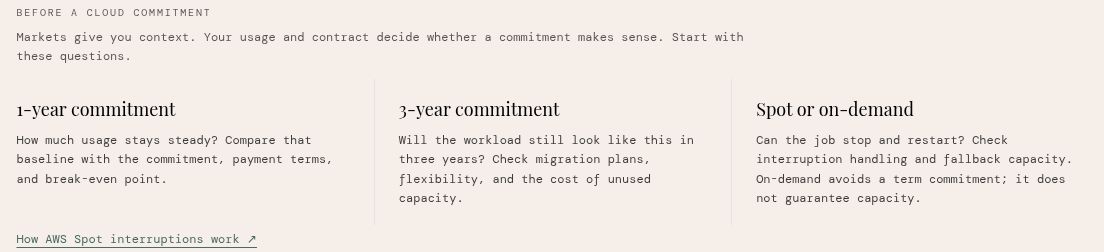
Then use Before a cloud commitment to bring the discussion back to your own business. How much usage stays steady? What might change over three years? Can a job stop and restart? Those answers, along with the actual prices and contract terms, help you evaluate a commitment.
Stock-market volatility can’t establish whether Spot capacity is safe for your workload. A software company’s valuation doesn’t tell you what discount its sales team will offer. Market context gives you questions to investigate alongside your own evidence.
Read Lumen with the numbers beside it.
Lumen adds an AI-written explanation of the snapshot. Check its numbers, units, dates, and conclusions against the dashboard and linked sources. It can still get things wrong.
Refresh analysis asks for analysis of the displayed snapshot; it doesn’t fetch a new live market quote. If the underlying snapshot has changed, reload the page. If analysis is unavailable, you can still use the dated data and fixed review questions.
An unavailable valuation stays Unavailable. An older figure labeled Archived is historical context. New analysis pauses when a snapshot is more than four days old; that backstop doesn’t replace checking the dates yourself.